
Roofing Tips & Guides
Expert Roofing Advice for Charlotte Homeowners
Learn from Charlotte's trusted roofing experts. Tips on maintenance, repair, replacement, and protecting your home from the elements.
Learn from Charlotte's trusted roofing experts. Tips on maintenance, repair, replacement, and protecting your home from the elements.

Lake Norman business owners face a harsh reality every summer: sky-high energy bills that eat into profits. With North Carolina's sweltering heat and humidity, your roof becomes a massive solar collector, forcing HVAC systems to work overtime just to keep employees and customers comfortable.
But what if I told you that the right roof materials could cut those energy bills by 30-40%? Not through some gimmick or temporary fix, but through proven science that's been saving businesses millions across the country.
I'm James Turner, owner of Best Roofing Now, and over the past decade, I've helped hundreds of Lake Norman businesses transform their biggest expense into their smartest investment. Let me show you exactly how energy-efficient roofing materials work and why they're the game-changer your bottom line needs.
Most business owners don't realize their roof is working against them every single day. Traditional roofing materials absorb massive amounts of solar heat, turning your building into an oven that your air conditioning has to constantly fight.
Here's what happens on a typical 95-degree Lake Norman summer day: A dark roof can reach surface temperatures of 150-190 degrees. That heat doesn't just sit there – it radiates down through your building structure, forcing your HVAC system to run at maximum capacity for hours longer than necessary.
The numbers are staggering. The average commercial building spends 40-60% of its energy costs on heating and cooling. In North Carolina's climate, cooling dominates those expenses from April through October. That's seven months of the year where your roof is either helping you save money or bleeding you dry.
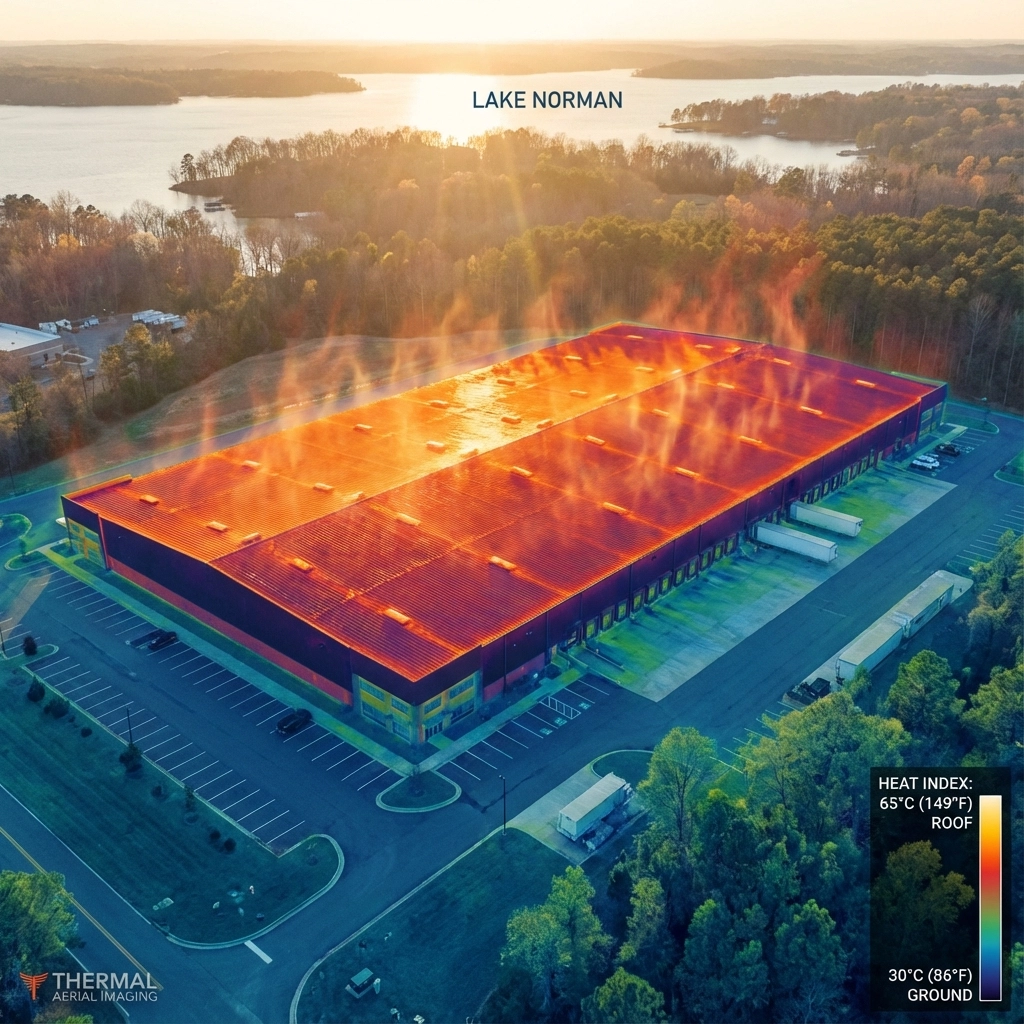
Energy-efficient roofing works on four fundamental principles that directly impact your energy bills: reflectivity, insulation, UV resistance, and moisture resistance.
Reflectivity is the superstar. High-reflectance materials bounce 70-85% of solar energy back into the atmosphere instead of absorbing it as heat. This isn't theory – it's measurable physics. The Lawrence Berkeley National Laboratory found that reflective roofing can reduce peak cooling demand by 10-15% and annual cooling energy use by 5-10%.
Superior insulation creates a thermal barrier that prevents heat transfer between your roof and interior spaces. When combined with reflective materials, proper insulation can reduce annual energy expenses by 15-25%.
UV resistance keeps materials from degrading under constant sun exposure, maintaining their energy-efficient properties for decades instead of years.
Moisture resistance prevents water infiltration that destroys insulation effectiveness and creates expensive structural problems.
Dr. Hashem Akbari, a leading researcher in cool roofing technology, explains: "The combination of reflective surfaces and enhanced insulation creates a compound effect. You're not just reducing heat gain – you're creating a system that maintains consistent interior temperatures with minimal mechanical intervention."
TPO has become our go-to recommendation for flat and low-slope commercial buildings throughout Lake Norman. The white, highly reflective membrane typically reflects 78-83% of solar energy, making it incredibly effective in our hot, humid climate.
What makes TPO special for businesses:
I've installed TPO on everything from small retail shops in Cornelius to large warehouse facilities near Lake Norman Regional Medical Center. The energy savings are consistent and immediate – most clients see 20-30% reductions in cooling costs within the first month.
Metal roofing offers unmatched longevity combined with superior energy performance. When enhanced with cool roof coatings, metal systems can reflect up to 70% of solar energy while re-emitting absorbed heat quickly.
The Lake Norman advantage with metal roofing:
One of our metal roofing projects on a 15,000 square foot office building in Huntersville resulted in $800/month energy savings during peak summer months. The building owner calculated a complete payback within 7 years, with decades of continued savings ahead.
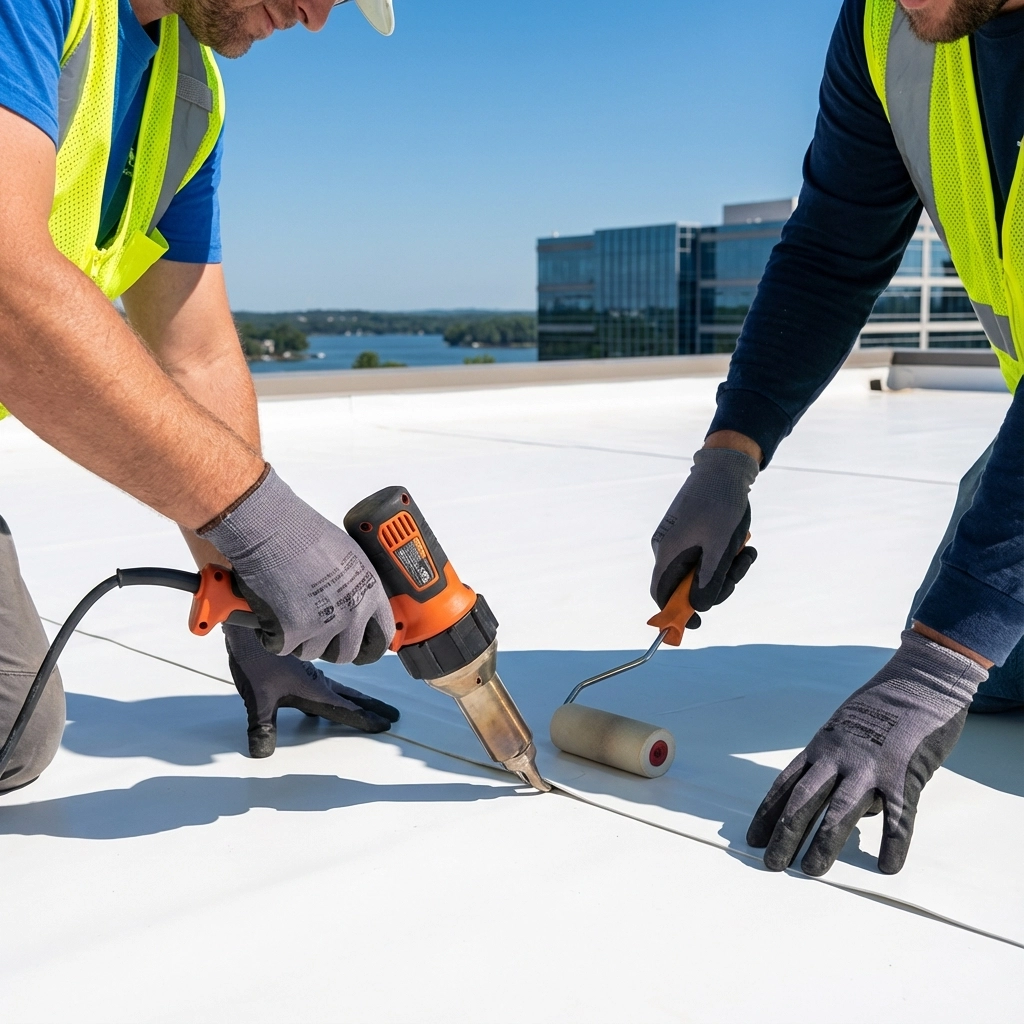
SPF roofing creates seamless insulation with reflective protective coating. This combination delivers some of the highest R-values available in commercial roofing while eliminating thermal bridging completely.
SPF benefits for Lake Norman businesses:
For businesses wanting to upgrade existing roofs without full replacement, reflective coatings offer outstanding value. White elastomeric coatings can transform a heat-absorbing surface into a solar reflector for a fraction of replacement cost.
We've applied cool roof coatings to dozens of Lake Norman businesses with remarkable results. A local manufacturing facility saw their roof surface temperature drop from 165 degrees to 95 degrees after coating application – a 70-degree difference that translated to $400/month in energy savings.
Let me break down the real numbers based on projects we've completed throughout the Lake Norman area.
Small Retail (2,000-5,000 sq ft)
Medium Office Buildings (10,000-25,000 sq ft)
Large Commercial/Industrial (50,000+ sq ft)
These numbers don't include additional benefits like extended roof lifespan, reduced maintenance costs, and potential tax incentives. The North Carolina Renewable Energy Tax Credit and federal energy efficiency deductions can significantly improve your return on investment.
Our local climate creates unique opportunities for energy-efficient roofing. With 2,800+ cooling degree days annually and summer temperatures regularly exceeding 90 degrees, reflective roofing materials work harder here than in cooler climates.
Humidity factors: Lake Norman's proximity to water creates high humidity levels that make buildings feel warmer at lower temperatures. Energy-efficient roofing reduces the heat load, allowing HVAC systems to focus on dehumidification rather than raw cooling power.
Storm resilience: Our energy-efficient materials are engineered for North Carolina weather patterns, including high winds, hail, and heavy rain events. TPO and metal systems excel during severe weather while maintaining their energy-saving properties.
Solar gain patterns: Lake Norman's latitude and typical clear summer days create ideal conditions for solar reflectance benefits. The sun angle and intensity make reflective roofing materials particularly effective from May through September.

We don't just install roofs – we engineer energy solutions tailored to each business's unique needs and budget. Here's our proven process:
Every project starts with a comprehensive energy audit. We analyze your current energy usage patterns, identify thermal weak points, and calculate potential savings with different material options. This isn't guesswork – we use thermal imaging and energy modeling to provide accurate projections.
Not every business needs the most expensive solution. We match materials to your specific building type, budget constraints, and energy goals. A warehouse with minimal climate control needs different solutions than a temperature-sensitive medical facility.
Energy-efficient upgrades qualify for numerous financing programs and tax incentives. We help businesses access:
Our installation teams are certified in all major energy-efficient roofing systems. We use advanced techniques like infrared scanning to verify proper installation and thermal performance. After completion, we provide performance monitoring to ensure you're achieving projected savings.
Energy-efficient roofing delivers benefits that extend far beyond lower utility bills:
Extended Equipment Life: Reduced HVAC runtime means less wear and tear on expensive mechanical systems. Many businesses save thousands annually in maintenance and replacement costs.
Improved Indoor Comfort: Consistent interior temperatures and reduced hot spots create better working conditions for employees and customers.
Property Value Enhancement: Energy-efficient upgrades increase property values and marketability, especially as sustainability becomes increasingly important to tenants and buyers.
Corporate Sustainability Goals: Green building practices help businesses meet environmental commitments and attract environmentally conscious customers and employees.
Insurance Benefits: Some energy-efficient materials qualify for insurance discounts due to improved fire resistance, wind resistance, or overall building resilience.
The roofing industry continues advancing with new technologies that improve energy performance:
Cool Roof Granules: Advanced ceramic granules in shingles reflect infrared radiation while maintaining color options beyond traditional white.
Phase Change Materials: New insulation systems that absorb and release heat to moderate temperature swings throughout the day.
Smart Roof Coatings: Coatings that change reflectivity based on temperature, maximizing energy efficiency in both summer and winter.
Integrated Solar: Metal roofing systems with integrated photovoltaic cells that generate electricity while providing superior weather protection.
We stay current with these innovations to offer Lake Norman businesses the most advanced solutions available.
Based on hundreds of projects, here are the most costly mistakes I see businesses make:
Choosing Based on Initial Cost Only: The cheapest roof will cost more in energy bills over its lifetime. Always calculate total cost of ownership including energy expenses.
Ignoring Insulation: Reflective materials without proper insulation provide limited benefits. The combination delivers exponential savings.
Delaying the Project: Every month with an inefficient roof costs money. Energy savings start immediately after installation.
Skipping Professional Energy Analysis: DIY calculations often miss important factors like thermal bridging, air leakage, and equipment interaction.
Not Considering Maintenance Requirements: Some energy-efficient materials require specific maintenance to maintain performance. Factor ongoing costs into your decision.
One of my favorite projects involved a 25,000 square foot medical office building in Davidson. The facility was struggling with $4,200 monthly cooling bills during summer months and frequent patient complaints about temperature inconsistencies.
We installed a TPO system with enhanced insulation and reflective coatings. The results exceeded expectations:
The building owner reinvested the energy savings into additional medical equipment and facility improvements. That's the power of treating your roof as an investment rather than an expense.
Energy-efficient roofing isn't just about staying cool – it's about maximizing profitability while reducing environmental impact. In Lake Norman's climate, the question isn't whether energy-efficient materials make sense, but which solution delivers the best return for your specific situation.
The businesses thriving in today's economy are those that make strategic investments in long-term cost reduction. Your roof is working 24/7, 365 days a year. Shouldn't it be working for your bottom line instead of against it?
Every day you delay is money lost to inefficient energy consumption. The technology exists today to slash your commercial energy bills while improving building comfort and durability.
Ready to discover how much your Lake Norman business could save with energy-efficient roofing? Contact Best Roofing Now for a comprehensive energy audit and custom solution designed for your building's unique needs. Call us at [phone number] or visit bestroofingnow.com to schedule your free consultation.
The roof over your head should be putting money back in your pocket. Let's make that happen.
Best Roofing Now
Charlotte's trusted roofing experts since 2019
Need help with your roof? Explore our professional roofing services in Charlotte NC.
Get a free roof inspection and honest assessment from Charlotte's most trusted roofing company.


